8 Crows and Again I Didnt See One of Them Nejji
It's Virtually Fourth dimension Birds Got a Little Respect
As we celebrate the Year of the Bird, Liz Spikol on how our feathered friends are much smarter than we requite them credit for.
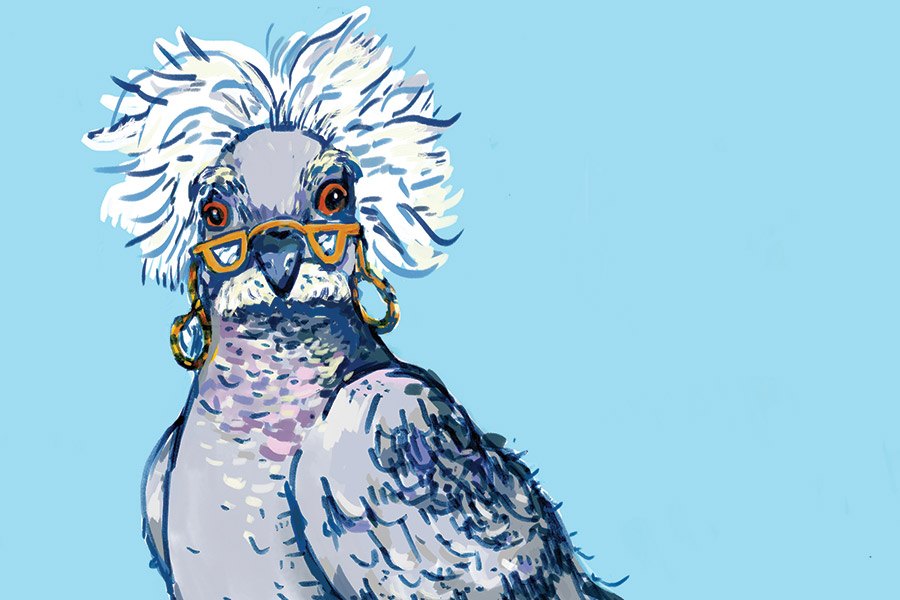
Illustration by Kelsey Zigmund
Several years agone, I heard a story on public radio that made me cry. This isn't unusual, of form. Between The Moth and StoryCorps, Reveal and Radiolab, I'm often a sodden, weepy mess by the time a show ends. But the program I remember so well wasn't even peculiarly sad. It was a thirteen-minute segment during which a tinnitus sufferer, Nubar Alexanian, spoke to his partially deaf young girl Abby virtually their divergent auditory challenges.
Despite her own bug, Abby had trouble imagining what it was like to live with a nonstop ringing in the ears, so he described it for her — and the show'due south canny sound engineers reproduced a clear, pure tone on top of the narration, so its intrusive nature could be fully understood.
Like Abby, I could non imagine how her father lived that way.
"That poor human being!" I wept, lone in my auto. "I would kill myself if I were him!" Typical Spikolian overstatement.
Funny thing is, not long later on that This American Life segment, I got tinnitus myself. And despite the nonstop ringing, intermittent clicking and distortions in audio that tinnitus has plagued me with, I haven't killed myself, or even considered information technology. Instead, I adjusted.
Humans are remarkably adaptable, able to survive war and rape, imprisonment and illness. Even the least resilient amidst united states — people like me who, as children, froze with terror when up at bat during Wiffle ball — tin can adapt to adverse circumstances so well that adversity becomes the norm.
In this style, nosotros're a lot like sparrows.
That's not as much of a not sequitur as information technology sounds.
My life in Philadelphia began with bird poop on my caput. It was one of the first days my mother had me out in the stroller, on a sunny summer day in Rittenhouse Square. We hadn't been out for more than a one-half hour when a splat landed on my forehead, prompting my female parent to run home and phone call the pediatrician in a panic. This did not endear birds to my mother.
All the same, my male parent managed to bring some home. There was Miles, a parrot who would say, "Art Spikol!" over and once again, mimicking the way my dad answered the phone. There was Chuckie, a bluish parakeet we had to give abroad when my female parent contracted a strange illness her doctor attributed to the bird. And there was sweet, personable Sydney, a pinkish-cheeked cockatiel who saturday next to the computer keyboard and stared at my father until Dad would take the bird's head in his palm and give him a cervix rub.
Though I was fond of all of these birds, equally I am of whatsoever living fauna that isn't human, I didn't develop meaningful relationships with them. Nor did I have particular notice of the birds I was surrounded by in the urban center.
But after I adult tinnitus, I noticed I could no longer have a peaceful moment in the Wissahickon, listening to the babble of the creek, the leaves in the cakewalk, the tock-tock of the woodpecker'due south bill against the tree. Birdsong more easily penetrates the auditory brume, just betwixt the tinnitus and my progressive hearing loss, I know there will come a mean solar day when I'll no longer hear it. Last year, I said something in passing to an older relative about birds singing outside the window. "What birds?" he said.
That scared me. I idea: I demand to start paying attending. Then, one time I did, I became the kind of person who will stop abruptly on the sidewalk merely to watch a sparrow peck a spud chip.
This radical conversion, it turns out, isn't unusual. National Geographic Books publisher Lisa Thomas, who conceived the arrangement's massive Year of the Bird project to commemorate the 100th ceremony of the Migratory Bird Treaty Human action this year, has seen it time and time once more.
"You lot're either a birder or you're not, and once your eyes are opened upwards, information technology'south like y'all go nigh insufferable, y'all get and so excited near birds and learning about them and studying them," Thomas says, as though she's been spying on me for a year.
Though I initially tried projecting a sort of hipster, Jonathan Franzen-style, cocktail-party-appropriate interest in birds — with an emphasis on environmental conservation and the importance of birds in nature — things quickly went off the track after I read The Genius of Birds, by Jennifer Ackerman. That book was filled with such shocking revelations that I acquit it effectually in my purse, pages domestic dog-eared, cover torn, so I can pull it out and read primal passages to whomever I'm with — usually my boyfriend, Brad.
"Do you lot realize the math that birds can do?" I'll inquire Brad over dinner.
"Do y'all know birds can distinguish humans and teach their offspring to recognize them, likewise?" I'll ask Brad over tiffin.
"Are you aware that many birds would, if given half the take chances, get higher SAT scores than virtually people we know?" I'll whisper in his ear during a movie.
Generally speaking, Brad does not know these things. That'due south non because he'southward ill-informed; he hosts Quizzo every month. Merely he doesn't know about birds because most people don't know about birds.
•
10 Things About Birds I'chiliad Pretty Sure Most People Don't Already Know:
1. They take intellectual abilities that rival those of primates.
2. They achieve mental feats at the level of a five-year-old.
3. While they all seem the aforementioned to united states, they are atypical to each other.
4. They can retrieve the by and learn from it too as plan for the time to come.
v. They have unique personalities that make up one's mind their beliefs.
6. They are capable of spontaneous, creative problem-solving.
7. Their brains have genes and neural circuitry similar to man brains.
8. They take a form of self-awareness, recognizing their ain images in mirrors.
nine. They demonstrate an sensation of other birds' perspectives and needs, suggesting potential theory of mind.
ten. They learn melodies the style humans learn linguistic communication and pass their knowledge down through generations.
This is merely a small sampling, and non all of these facts apply to all birds. Some birds are less impressive than others, certainly. But the breadth of cognitive ability and diversity of blazon in birds is adequately remarkable.
The corvid family — crows, ravens and the like — is especially prodigious. In Japan, for case, crows have been known to hop into the route, place basics in the line of traffic, and and then wait for cars to drive over the nuts to pause them open. If a particular nut is being bypassed by also many cars, they get out and reposition it.
Crows likewise understand analogies and have been known to limited gratitude to humans past bringing them gifts. They fifty-fifty have their own version of hoagie mouth, communicating in distinct regional dialects. I could go on. At this betoken, I'g so in awe of crows that when I see 1 sitting in a tree, I get starstruck, clapping and grinning and staring as though Beyoncé is sitting up there belting out songs from Lemonade.
You might wonder why you didn't know all this — why no one mentioned that bird brains have fascinating parallels with human being brains. I think it'southward partly because human beings have a terrible habit of underestimating animals, especially those that they don't consider novel. Birds go taken for granted, which is a shame, since ane of the best things about them is their abundance.
"Not everyone has a tiger in their backyard, but everyone has a bird," says NatGeo's Thomas. "And then birds are a piece of the natural world that connects every single person on the planet. Everyone has birds that are native to where they live, and because birds travel over such nifty distances, birds are truly global citizens."
All of this is truthful and yet non sufficiently persuasive to make the states feel as excited about seeing a bird as we would be if nosotros saw a tiger cub scavenging for crumbs on the platform at 30th Street. My theory is that'due south considering birds aren't beautiful. Thomas agrees: "Information technology's a lot easier to raise money for tigers. The cubs are so cute and cuddly, so they're relatable," she says.
Nosotros simply seem to adore birds that remind us of ourselves, like penguins, or that do human being-ish tricks, similar a cockatoo that dances to Pharrell Williams's "Happy" or the African grey that uses Alexa to plow on the lights.
Otherwise, it takes effort to get all "awwww" about a bird. Merely it can be washed.
•
The house sparrow, Passer domesticus, has a remarkable power to adapt to new circumstances, particularly if those circumstances accept been created by humans. Sparrows were introduced to the U.S. in 1851, when some genius brought 16 of them to Brooklyn to control the moth population. You see where we are now: They're everywhere. And sparrows — with their funny little hops and peeps — are undeniably cute. They all expect a little like Spanky from The Little Rascals.
In Philadelphia, the sparrow is especially common. According to a 2016 bird breeding census helmed by Matthew Halley and Tony Croasdale, who works for the department of parks and rec as an environmental educator, approximately 101 species of birds nested in Philadelphia that year, with the most arable being the American robin, the European starling, the gray catbird, the house sparrow, the Canada goose, the common grackle and the red-winged blackbird.
In The Genius of Birds, Ackerman marvels at the sparrow'due south ability to nest in whatever man-fabricated structure, from a coal mine to the tailpipe of an abandoned machine. She also writes about the urban detritus that sparrows collect in social club to make their nests. Before long afterward I read about sparrows in that book, I was climbing the stairs of a bland concrete parking structure. On the landing betwixt floors three and four, I noticed a pile of schmutz — that'due south the actual word that came to heed. It wasn't quite trash, but information technology wasn't not trash, either. I started to walk by, and then I heard a peeping and saw a sparrow darting back and forth. I remembered what Ackerman said almost sparrows holing up in the built surround, and I looked more closely at the pile of schmutz.
Turns out it was the remains of a nest that had been constructed out of Scotch record, plastic wrap, cigarette filters, and other human being castoffs. It was something to behold there in that sterile environment — a sign of creativity and accommodation and determination to survive.
Information technology brightened my whole twenty-four hour period to see that messy pile, as it did to notice that on the Avis edifice at 20th and Curvation, which is at present empty, sparrows have created a nest in the red sign, correct in the hollow of the letter A — a particularly apt adaption given that "avis" ways "bird" in Latin. Learning about birds has made the city more wondrous for me.
And Philadelphia is pretty amazing when information technology comes to birds. Merely ask Croasdale.
"We have a very large park arrangement, our very own wildlife refuge, we're on a giant river, and nosotros're very close to the declension, so birds migrating down the coast will frequently land hither," Croasdale says.
Croasdale was a 9-twelvemonth-old Cub Scout when an environmental educator at Pennypack Park told him a story about a velvet kingfisher. "I thought it was some exotic bird y'all had to see far away," he says. The educator at Pennypack set him straight: "He said, 'No, you lot can see information technology right here in the park.' The next week, I went and saw them. I've been an avid birder since then."
Croasdale appreciates the fortuitous nature of bird appreciation: "Considering they fly and migrate, they can show up in random places. You can live in the middle of the city and get a rare bird at your bird feeder. Yesterday I saw a gyrfalcon. That's an Arctic falcon that you meet in Newfoundland or the Canadian prairies in the winter, but non in New Jersey. And then stuff like that is awesome."
Crawly is the perfect word. There's and so much virtually bird life that is unexpected and stunning and fifty-fifty securely poignant — and I'm talking This American Life poignant. And while I'm afraid not everyone can have my luck of pairing tinnitus with progressive hearing loss, thus triggering a panicked investigation into a express resource, you can learn just a lilliputian flake more about the birds you encounter every day.
I mean, do you know that pigeons can tell the divergence between a Picasso and a Monet? It's true! Something to recollect about the next time i poops on your head.
Published as "Bird Is the Word" in the May 2018 consequence of Philadelphia magazine.
Source: https://www.phillymag.com/news/2018/04/28/year-bird-liz-spikol/

Post a Comment for "8 Crows and Again I Didnt See One of Them Nejji"