Artlabeling Activity the Structure of the Dermis and the Subcutaneous Layer
The human skin and its related structures are known as the integumentary organisation. It is the largest organ in the trunk measuring two square meters in the average adult. Being the outermost construction, it is oftentimes the focus of much attention with a poor agreement of its beefcake and physiology. It tin can exist considered every bit the about resilient organ in the homo body every bit information technology is bombarded on a daily ground with a number of insults yet is able to withstand these attacks and continue performance throughout life.
Layers of the Human being Skin
The skin is composed of 2 layers, the outer epidermis and deeper dermis. There are 2 other layers worth noting, namely the basement membrane between the epidermis and dermis, and the hypodermis / subcutis below the dermis. These layers are often considered as office of the epidermis and dermis.
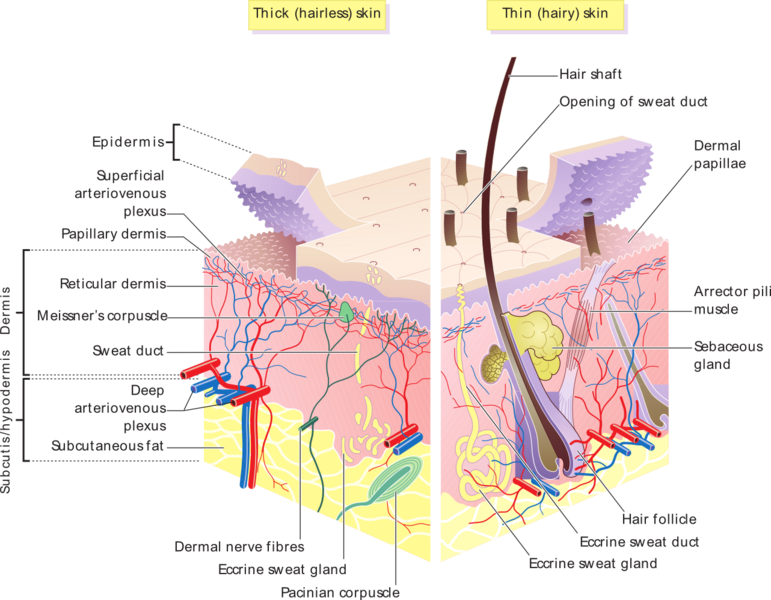
Picture from Wikimedia Commons
The Epidermis
The epidermis is the outermost layer of skin about 0.1 to 0.2 millimeters thick. It is made up of 4 types of cells :
- the keratinocytes which make up 90% of the epidermis,
- the Langerhans cells, melanocytes and Merkel cells which constitute the remaining ten% of the epidermis.
The keratinocytes, autonomously from existence the virtually abundant of the epidermal cells, are also the most important in that it allows the skin to conduct its about basic function – protecting the internal environment of the trunk. It does this by manufacturing a number of proteins, mainly the different types of keratin, as well as lipids. As these cells emanate from the deepest layer of the epidermis known as the stratum basale (or stratum germinativum), information technology undergoes various stages of rearrangement and apoptosis (prison cell death).
Past the time this process is complete, the outermost layer of the epidermis (stratum corneum) is made up of these dead highly-keratinized cells sealed by a layer of lipid and arranged in a mode that creates a firm, waterproof barrier. These gradual changes between the stratum basale and straum corneum contributes to the different arrangements seen as the five layers of the epidermis. This includes :
- Stratum basale (innermost)
- Stratum spinosum
- Stratum granulosum
- Stratum lucidum
- Stratum corneum (outermost)
The epidermis has no claret supply of its own but receives oxygen and nutrients from the highly vascularized dermis. This travels beyond the basement membrane that anchors the stratum basale of the epidermis to the underlying dermis. The other types of epidermal cells also play important roles in the performance of peel.
- Langerhan cells play an of import function allowed activeness by exposing strange antigens to lymphocytes.
- Melanocytes synthesize the pigment melanin which protects the skin against ultraviolet calorie-free.
- Merkel cells may play a part in the sense of touch although this has not been conclusively substantiated.
The Dermis
The dermis is the deeper layer of the peel separated from the epidermis by the basement membrance. Information technology is almost ane to iv millimeters thick and contains a variety of cells which carry out many dissimilar functions. The dermis contains a vast network of nerve endings, claret vessels and connective tissue. The main type of cell found in the dermis is the fibroblast which produces various fibers like collagen and elastin. A number of different types of immune cells are also abundant in the dermis. Broadly, the dermis tin can be divided into ii layers :
- the papillary dermis which lies superficially,
- the recticular dermis which lies deeper.
The papillary dermis is so named considering of the number of dermal papillae that extend into the epidermis. It is composed of loose connective tissue. The deeper and coarser reticular dermis is abundant in collagen, elastin and fibrin which gives pare its elasticity, firmness and forcefulness.Diverse appendages of the integumentary organisation, like the hair, sweat glands and nails, are either rooted in the dermis or emanate from the dermis.
The hypodermis is non part of the peel but is often discussed in conjunction with the dermis. This layer anchors the dermis to underlying tissue and information technology contains a layer of fatty (subcutaneous) to insulate the torso.
Source: https://www.healthhype.com/human-skin-anatomy-structure-of-epidermis-and-dermis-layers.html

Post a Comment for "Artlabeling Activity the Structure of the Dermis and the Subcutaneous Layer"